
Why we built Chip before asking clients to trust AI with execution.
Chip began as an internal AI operating system. It became something more valuable: a working laboratory for understanding organizational readiness, execution clarity, decision context, and the silent failure patterns that appear when work starts moving faster than the operating model.
Proof of work • Built internally • Applied to client readiness
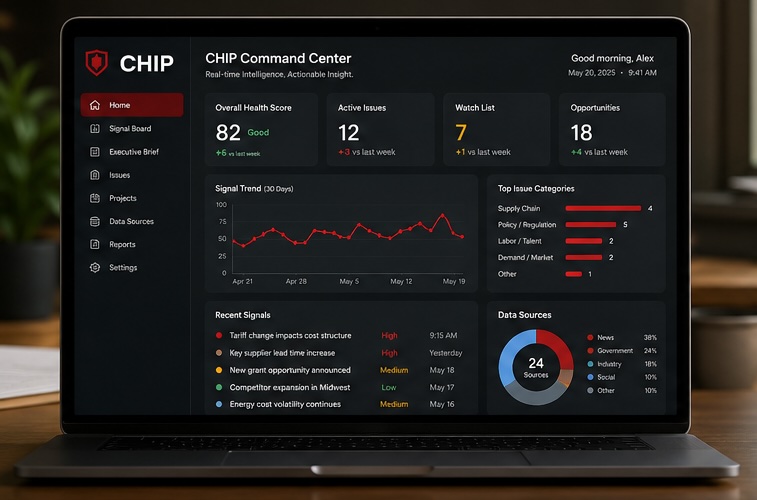
We built Chip because activity was scaling faster than organizational clarity.
We did not build Chip because we wanted another AI assistant. We built it because RB Consulting had the same problem many growing organizations have: too many conversations, too many systems, too many decisions, too much information, and not enough operating clarity.
Building Chip taught us something important: AI was not the missing piece. Organizational readiness was. The hard work was deciding what mattered, who owned what, which signals could be trusted, where human judgment belonged, and how scattered activity should become decision-ready context.
The core idea
AI value does not come from more output. It comes from making the organization more ready to see, decide, and act.
Signals lived in messages, notes, calendars, CRM activity, drafts, and memory.
The bottleneck was not AI capability. It was organizational structure and clarity.
Planning, follow-up, content, pipeline, and decision-making became easier to inspect.
The work was visible. The operating picture was not.
As RB Consulting’s work expanded, the daily reality became familiar to many growing organizations: more client work, more outreach, more partner conversations, more content opportunities, more proposals, more follow-up threads, and more decisions. Each piece mattered. But no single system told the full story.
Signal fragmentation
Important context was scattered.
Prospect replies, podcast notes, call outcomes, LinkedIn engagement, proposals, client delivery, and content ideas created useful signals — but they were not naturally connected.
Manual reconstruction
Planning required too much memory.
Weekly planning depended on remembering what happened, which conversations mattered, what follow-ups were owed, and where momentum was building.
Readiness drag
Activity could increase without clarity improving.
More output is not the same as better execution. Without structure, the highest-value signals can get buried under the volume of work.
The difficult work was not building AI. It was making the organization ready to use it.
Chip exposed the same readiness work we now look for in client environments.
Defining what information actually mattered.
Clarifying ownership for follow-up, interpretation, and decisions.
Separating useful signals from activity volume.
Agreeing on source-of-truth and operating rhythm.
Determining where human judgment needed to stay in the loop.
Turning scattered outputs into decision-ready context.
Chip helped us name the patterns we now diagnose.
Building Chip did not eliminate every operating challenge. It helped us see them more clearly. Those patterns became part of the readiness lens RB Consulting now uses with clients.
Pattern
Ownership Vacuum
Important work moves forward, but no one clearly owns the final outcome or exception path.
Pattern
Decision Drift
Decisions slowly move away from original intent because the operating context keeps changing.
Pattern
Workflow Blindness
The documented process looks clean, but the real work depends on hidden steps and judgment.
Pattern
Trust Collapse
People verify, bypass, or ignore outputs because they do not fully trust the data or process.
Pattern
Data Reality Gap
Reports and dashboards exist, but they do not reflect how work actually happens.
Pattern
Integration Mirage
Systems appear connected, but the organizational rules underneath them are still misaligned.
Chip was built as an operating layer, not just an AI assistant.
The first design decision was simple: Chip should not be a novelty interface. It should help RB Consulting see the business more clearly and make better decisions with less reconstruction.
That meant organizing the system around the flow of work: inputs, normalization, context, decisions, actions, and learning.
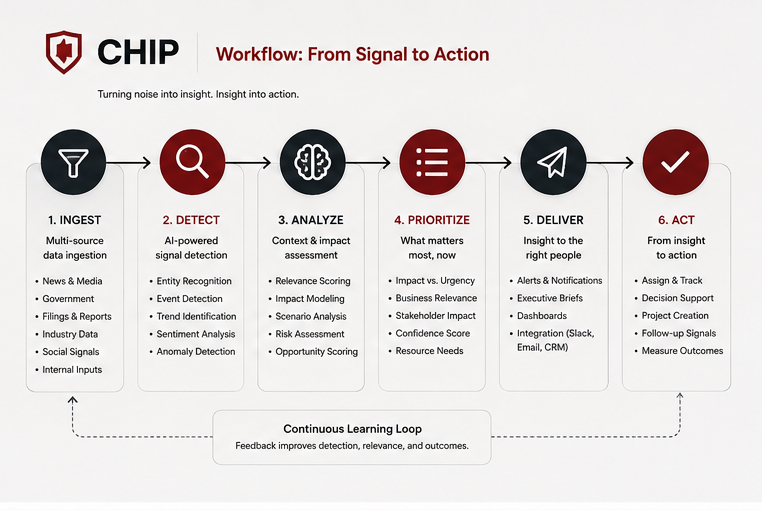
The five layers behind Chip.
Each layer was designed around an operating question, not a technology preference.
Input Layer
What signals need to be captured before they disappear into memory, messages, or scattered systems?
Context Layer
How do we normalize activity into operating context that can be reviewed without reconstructing the week?
Decision Layer
Which priorities, blockers, weak signals, follow-up needs, and drift patterns require attention?
Action Layer
How do insights become follow-ups, briefs, content prompts, pipeline actions, and weekly priorities?
Learning Layer
What creates momentum, what stalls, and which patterns should influence future planning?
Chip made the business easier to inspect.
The immediate value was not automation for its own sake. It was better visibility into what was happening, what mattered, what was drifting, and what needed attention next.
01 / Daily operating view
Daily reconciliation
Chip helps turn daily activity into structured updates: what moved, what stalled, what needs follow-up, and where time is being spent.
02 / Planning support
Weekly operating briefs
Instead of starting planning from a blank page, Chip creates a decision-ready brief that summarizes momentum, risks, pipeline signals, and next best actions.
03 / Relationship signal
Outreach signal tracking
Chip connects engagement, DMs, replies, calls, and follow-ups into a more coherent view of relationship momentum.
04 / Pipeline context
Pipeline interpretation
The system distinguishes raw activity from meaningful opportunity signals: executive conversations, advisory interest, partner potential, and proposal momentum.
05 / Reusable insight
Content leverage
Chip helps turn conversation patterns into stronger LinkedIn posts, podcast angles, proposal language, and thought leadership assets.
06 / Drift control
Execution drift detection
When planned priorities and actual activity diverge, Chip helps make that drift visible before it becomes a lost week or missed opportunity.
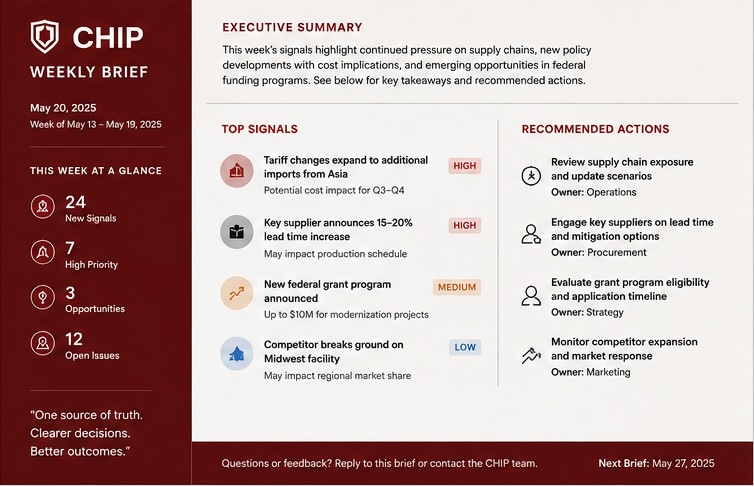
Example output
From scattered updates to a weekly operating brief.
One of Chip’s most useful outputs is the weekly brief: a structured view of progress, open loops, pipeline movement, content opportunities, blockers, drift, and decisions needed.
A useful brief should answer:
- What actually moved this week?
- Which conversations or opportunities deserve attention?
- What follow-ups are at risk of going cold?
- Where did activity fail to match the plan?
- What should be the next highest-leverage action?
The lessons apply far beyond RB Consulting.
Chip became a practical proof point for the organizational readiness principles we now use with clients.
1. AI does not fix readiness. It exposes readiness.
If ownership, workflow, data, and decision rights are unclear, AI simply accelerates the confusion.
2. Better information does not automatically produce better execution.
The organization needs usable operating context, not just more summaries, dashboards, or outputs.
3. Every automation inherits organizational weaknesses.
Automation does not remove unclear ownership, brittle handoffs, inconsistent data, or weak decision paths. It usually makes them visible faster.
4. Readiness can be measured.
When the right signals are captured, leaders can see where execution will drag before they commit more budget, people, or tools.
Chip is not what clients buy.
Clients do not hire RB Consulting because they want Chip. They hire us because we learned — by building and operating Chip ourselves — that successful AI, automation, and modernization depend far less on tools than on organizational readiness.
Chip is the laboratory where we continue testing these ideas. The client value is the methodology that emerged from building it.
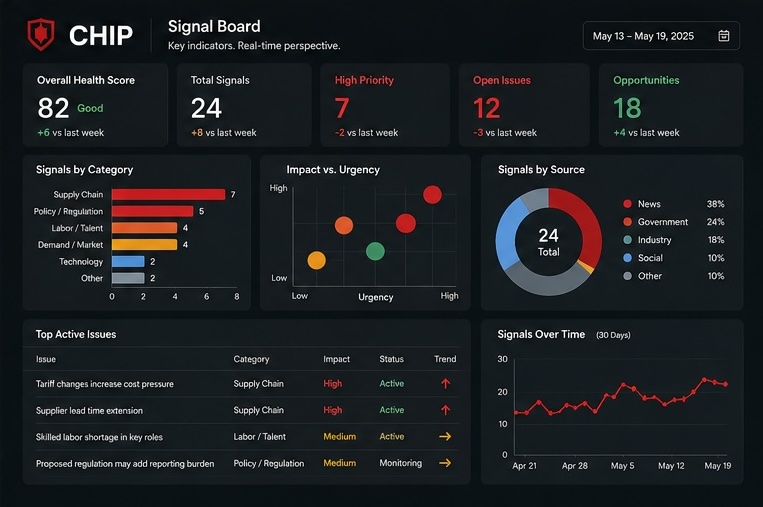
Where is work becoming harder to interpret, coordinate, or trust?
Map organizational readiness before adding more tools, automations, or AI workflows.
This is the kind of work Chip helps explain.
Organizations usually need readiness work when they recognize these patterns.
Your teams have more tools than clarity.
Leadership receives updates but still struggles to see the real operating picture.
AI pilots are creating outputs, but not better decisions.
Follow-up, ownership, or handoffs depend too much on individual memory.
Metrics exist, but they do not tell you what to do next.
You need a practical bridge between strategy, workflow, data, and execution.
Wondering whether your organization is ready for what comes next?
Most organizations do not need another AI project first. They need a clearer understanding of how work actually flows, where decisions stall, which signals can be trusted, and what must change before technology can create lasting value.
Start with the Execution Readiness Check. If deeper issues emerge, RB Consulting can help map the organizational changes that unlock sustainable execution.
Start a conversation
Tell us what is getting harder to coordinate, evaluate, or trust. We’ll respond with next steps.
By submitting, you agree we can contact you about your request.