
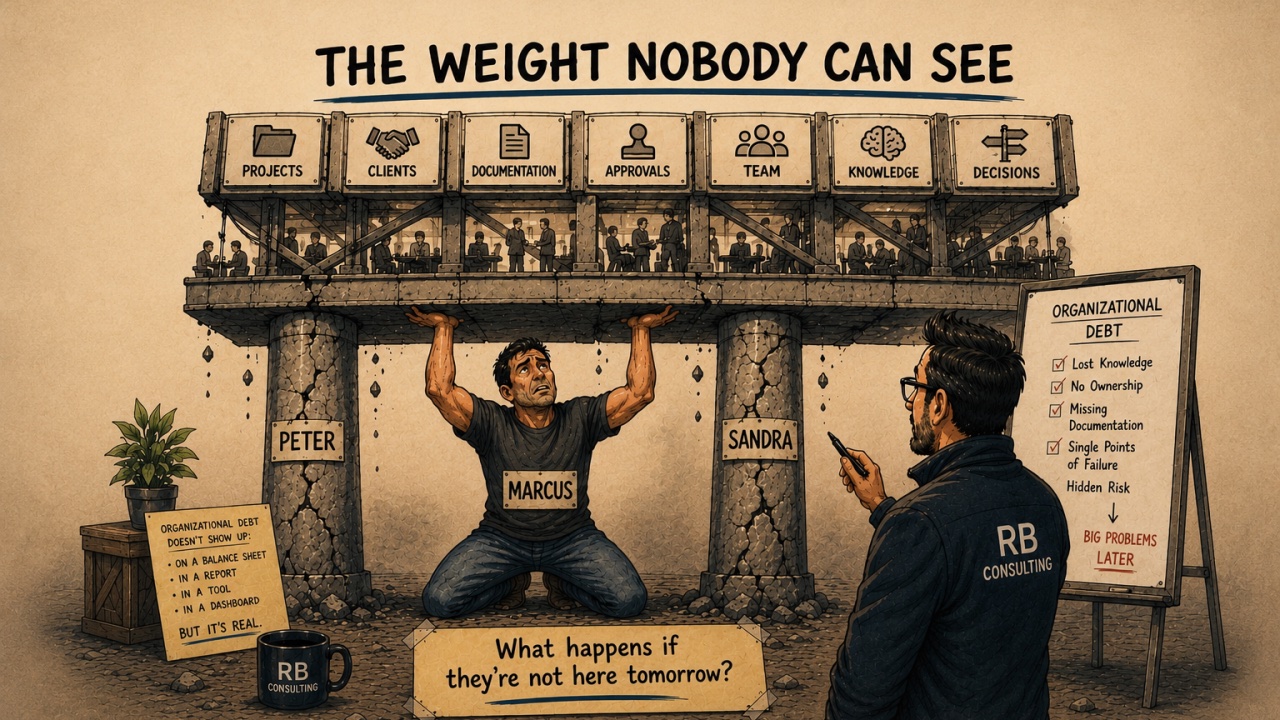
In the first session, Marcus described the chaos. In the second, Rob started looking for what was causing it.
One question kept surfacing: how many of these problems are actually technology problems?
Almost none of them.
In Episode 3, the picture gets a lot clearer. And a lot more uncomfortable.

Eight people. Three days. Ten departments.
Nobody knew exactly how the environment worked. The documentation was outdated. The tickets assumed knowledge that no longer existed. And the one person who understood how everything fit together was being pulled in four directions at once.
They got it running by Friday at 5pm.
Then came the question that reframed the entire week.
“If this happens again in six months—what’s different?”
Silence.
That silence was the whole story.
When asked what had surprised him most from the week’s homework, Marcus barely paused.
“Not much, really. I’ve known for a while that I’m the bottleneck in about everything.”
Not frustrated. Not defeated. Just matter-of-fact. The way you talk about something you’ve been carrying so long it stopped feeling like a weight and started feeling like weather.
Marcus had spent three days paying down debt he didn’t create.
Decisions nobody had documented. Systems nobody had explained. Knowledge concentrated in people who had already left—and nobody had thought to ask them to write it down before they walked out the door.
The organization had been accumulating that debt for years. The invoice had simply arrived on his desk.
This is what organizational debt looks like in practice. Not a line item on a balance sheet. Not an alert in a monitoring system. Just eight people in a call room for three days, reconstructing what should have already existed. Every hour spent rediscovering how the system worked was an hour not spent on the merger work leadership actually cared about.
The kind of debt that accumulates quietly, invisibly, until something breaks and the cost lands all at once on whoever is closest to the problem.
“They don’t even know what they don’t know.”
That’s what made it so hard to fix. You can’t document what you don’t know is missing. You can’t transfer knowledge nobody realized was concentrated. And you can’t build a system resilient enough to survive the loss of a key person until you’ve honestly answered the question: what happens if that person isn’t here tomorrow?
For Meridian, the answer was sitting in front of everyone and nobody had looked at it directly. Ryan was the single thread the entire project ran on. The PO relied on him. The manager relied on him. The VP relied on him. Eight teams building toward a merger deadline were all waiting on a token that only his team could provide—and his team was, functionally, Marcus and Cherise.
“If Ryan leaves tomorrow—you’re dead in the water.”
Marcus didn’t flinch. “We’re not gonna make our deadlines. We’ll figure it out. But we’ll essentially be starting over.”
Then, almost quietly: “I don’t know. I’ve lost track of days at this point.”
Just a man so deep inside a situation that the calendar had stopped making sense.

What surprised Marcus wasn’t finding the problem at Meridian.
It was finding the exact same pattern somewhere completely different.
At Hargrove & Associates, everything flowed through Sandra. Not because it needed to. Because it always had. She ran the practice, approved the decisions, managed the staff, and served as the gatekeeper for everything—including access to her own employees.
One afternoon Marcus needed fifteen minutes with Claire.
Not a strategy session. Not a multi-day workshop.
Fifteen minutes to resolve a training issue.
He spent nine hours in the office waiting.
Not because Claire was unavailable.
Because nothing happened at Hargrove until Sandra said so.
When Sandra had been out sick earlier in the engagement, the practice hadn’t slowed down. It had stopped. Different company. Different industry. Different structure entirely.
Same dependency.
“This is an organizational flaw that you are essentially paying the price for.”
Marcus was quiet for a moment.
“I just want this done. I want it done.”
The weight of months in four words. Not frustration at the work. Frustration at what the work had cost him. The weekends. The hours he should have been building Apex Systems. The coworking space he hadn’t been back to in almost a year.
“It really pisses me off,” he’d said earlier, almost in passing. “Because that place really helped.”
The last space that was purely his. Somewhere in the accumulated weight of the last year, he’d lost it.
The homework was the most structured yet.
For both Meridian and Hargrove, map every critical role. The person currently carrying it. Then apply a stress test: if that person was completely unreachable for thirty days, what stops in week one? What backs up by week two? What becomes a genuine crisis by week four?
And then the question that gives the exercise its teeth: what is the smallest thing that could reduce that risk? Not eliminate it. Just move the needle enough to buy some breathing room.
Because here’s what the exercise was really about.
It wasn’t documentation. It wasn’t cross-training. It wasn’t succession planning.
It was visibility.
Most organizations don’t know where their risk actually lives. They know who works hard. They know who gets things done. They know who everyone calls when there’s a problem.
What they don’t know is what happens when that person isn’t there.
Marcus could already see it applying everywhere—at Meridian, where Ryan was genuinely required but some of what flowed through him did so by habit. At Hargrove, where Sandra had become the single point of failure not because the work required it but because that’s how things had been allowed to develop. And quietly, closer to home—the same question turning toward Apex Systems. Toward his own role. Toward the pattern that kept showing up no matter where he looked.
He was the bottleneck. He’d said so himself at the start of the session.
Now he was starting to understand why.
Most owners think they’re fighting fires.
Often they’re paying interest.
Interest on decisions nobody documented.
Knowledge nobody transferred.
Dependencies nobody questioned.
Organizational debt doesn’t disappear because you ignore it.
It compounds.
And eventually someone has to pay it.
Next week Marcus brings back the role map. For the first time, the debt has names.