
Some names and identifying details in this series have been changed to protect client confidentiality. The consulting process, conversations, and outcomes are real.

Marcus arrived on three hours of sleep.
Hargrove was going live. Meridian Financial was deploying to production that night. He was triple-booked for the week — 75 hours scheduled before accounting for this session, closer to 90 when everything was added up. The previous night he’d stayed up fixing a critical billing error that had appeared without warning. He’d gotten it working. He thought.
“I’m so burned out with them,” he said, about Meridian. Then, quieter: “I’m burned out with tech.”
Hargrove had asked him to migrate the entire system to Windows servers — something that wasn’t in any original agreement, work that belonged to someone else’s scope and budget. He hadn’t invoiced for it.
Rob pushed back. That was a major scope change. Invoice them. Set a deadline. Walk away if they won’t meet it.
Marcus heard it.
“I can’t squeeze blood from a turnip. I just need to get this done and get out of here.”
“I’m losing on all sides.”
He said it plainly. Not looking for sympathy. Just naming where things stood. Rob let it go. Some fights weren’t his to win for Marcus. Marcus knew the situation better than anyone, and he’d made his call.
There was something else underneath all of it. A timeline Marcus had been carrying without stating it directly. Hargrove was going live this week. After that, two weeks, then Meridian’s first production deployment. Six weeks after that, the second. By the time both were done, his contract at Meridian would almost certainly be over — and he’d need to know whether Apex Systems was something real, or whether he was starting his job search again.
“I’m on a deadline.”
Three interviews had happened since last week.
The first — with a business owner named Greg — had gone the way most early discovery conversations go. Useful but not revelatory. Marcus was still learning what questions to ask, still catching himself leading toward answers he already expected.
The second was with Bill.
Bill was different. He’d watched himself improving in real time — starting to ask more openly, steering less, letting Bill describe his situation rather than confirming Marcus’s assumptions about it. The improvement was small. But he could feel it.
The third interview was unlike either of them.
He’d called Maverick — a founder who’d built companies before and had strong opinions about how to build them again. The first fifteen minutes went the way Marcus expected: Maverick described his current company, what they were working on, how they were using AI to solve a specific data problem.
Then something shifted.
Maverick pivoted, started asking Marcus what he’d found so far, what ideas he was developing, what directions he was considering. And Marcus told him. And from that point forward, the conversation belonged to Maverick.
“He was off and running with product ideas for almost 45 minutes.”
Maverick was convinced Marcus should build a tool. Something AI-powered, focused on contractors — a system where you could walk around a job site, scan the environment, and get back material estimates, measurements, and man hours in the time it takes to circle a house. Specific. Compelling. The kind of idea that arrives with its own momentum, that makes you want to start sketching it out before the call is even over.
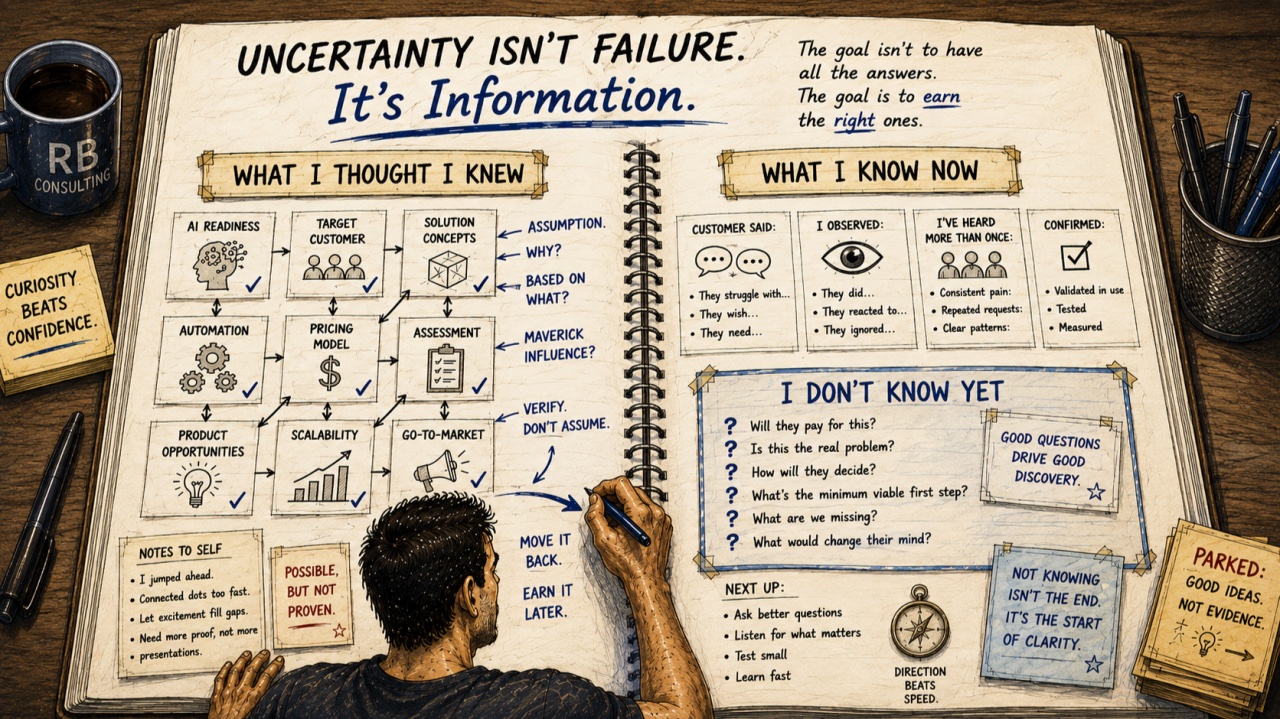
Marcus knew the feeling. He’d felt it before. He knew exactly what happened next — the notebook comes out, the architecture starts forming, the hours disappear, and three days later you’ve built something nobody asked for.
“I took them down and put them aside. Because I don’t think I’m ready for that yet. I don’t want to build something no one wants — by not understanding the problem.”
He said it without drama. But for anyone who had been following this story from the beginning, that sentence landed differently than it would have two months ago. This was a man who had spent weeks building thirty pages of assessment documentation instead of making three phone calls. Who had arrived at meeting after meeting with elaborate frameworks and pricing tiers for customers he hadn’t yet spoken to. Maverick had handed him forty-five minutes of compelling product vision, and Marcus had put it in a drawer.
He’d also tried to push back during the call — asking Maverick how he’d approached customer conversations at his previous company, whether he was as directly engaged with customers now. Maverick had momentum and kept it. Marcus couldn’t reel the conversation back.
“I lost control of the conversation. And I really couldn’t reel it back much till the end.”

Rob asked which of the three conversations he felt most certain about.
Marcus thought about it.
“I think I’m on the right path. But I haven’t figured out or understood the problem enough to build something. It’s not neat enough to go after a particular market yet.”
He was narrowing. Two directions had emerged from the interviews: AI readiness assessments for technically inclined businesses trying to figure out how AI fit into what they already had, and operational assessments for non-technical small business owners — people like Bill, running things on memory and paper and needing help making their businesses legible to themselves.
“I want to pick one lane to start.”
Rob asked what the interviews had changed. What did Marcus see differently now than he had at the beginning?
“I’m shying away from the larger assessments. I’m thinking more — one or two smaller assessments. Really niching down. Instead of an assessment that fits every situation, I want one that fits one situation.”
Rob asked which direction felt better.
“Right now, Bill — just because he’s there, he needs the help now.”
He heard himself say it.
“Let’s take Bill out of the equation,” came the response. “Which customer — which work, which project — actually gets you excited? The AI customer, or the smaller customer who doesn’t understand technology?”
Marcus didn’t hesitate.
“Probably the smaller customer.”
Then, a beat later, catching something:
“And I think the AI thing came from copying Maverick more.”
He said it the way you say something you’ve just realized is true.
The homework wasn’t a decision.
Rob was clear about that. Marcus wasn’t being asked to choose between the two paths. He was being asked to compare them — seriously, specifically, without yet committing to either.
What does the customer look like? What would a realistic engagement look like? What does the business become in one year if this direction works, and in three? What kind of reach does it require? What questions do the interviews still need to answer?
Not a product. Not a tier structure. Not a pricing model.
Just: what do you actually know about each of these, and what are you still assuming?
Marcus already had one concrete next step in mind. He was going to reach out to the local Chamber of Commerce. Not to pitch anything. To understand who was in the room, how to reach them, and whether the people he was looking for were the kind of people who showed up there. Another conversation designed to test an assumption before it hardened into a plan.
And Bill was still out there. AWOL on a job site, unreachable because the rains last week had put him behind on a contract and his cell phone had no satellite. Marcus had been trying to reach him. He’d get back eventually.
He left with two directions and fewer certainties than he’d arrived with.
