
Some names and identifying details in this series have been changed to protect client confidentiality. The consulting process, conversations, and outcomes are real.

Marcus came in with something to show.
Three discovery interviews. A refined understanding of his target customer. A proposal built around Bill’s specific situation — one problem, one budget, a clear scope. He’d done the homework, organized the findings, and arrived ready to walk through what he’d put together.
The session began as a review.
It became something else.
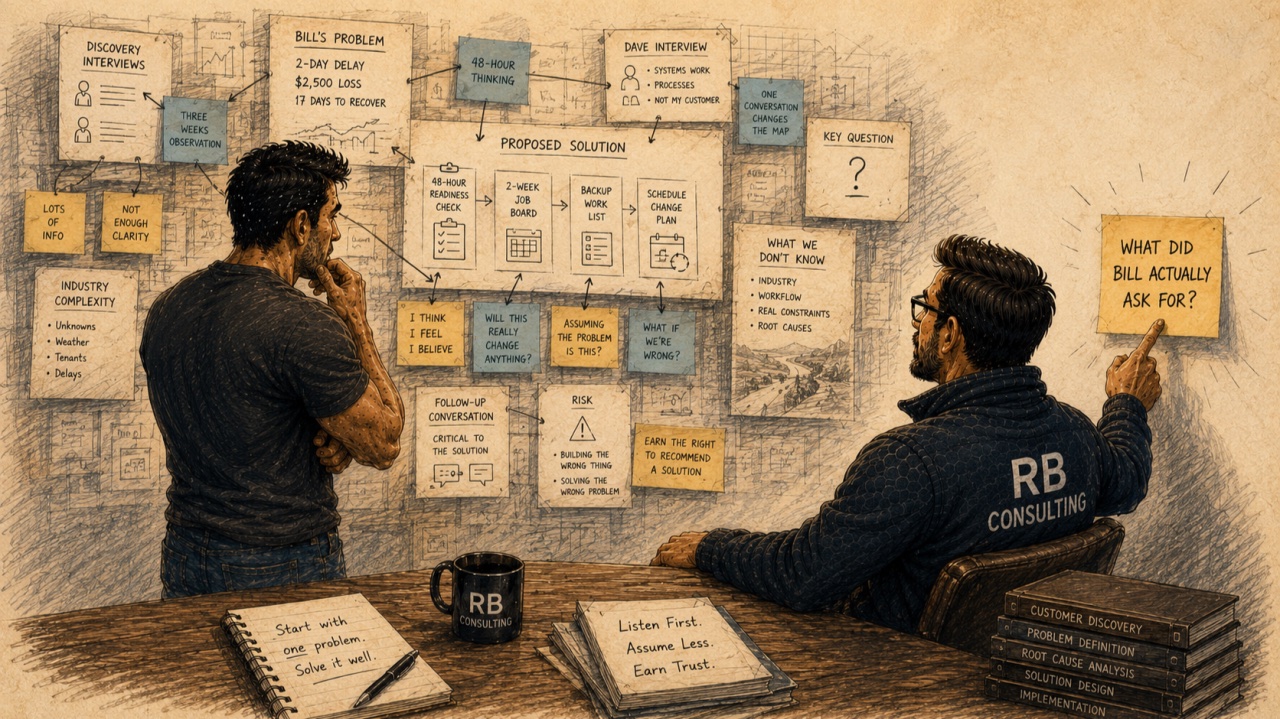
The proposal was thorough. Marcus walked through it: a 48-hour job readiness check, a two-week crew and job board, a backup work list, a plan for schedule changes. Each piece tied back to Bill’s problem — a two-day delay that cost him $2,500 and seventeen days to recover from. The logic was coherent. The scope felt contained.
Rob asked about the hourly rate.
Marcus ran the math. Around $125 an hour, about twenty hours of work, roughly $2,500. It fit.
“Can you get the four deliverables done in twenty hours?”
“I think so.”
Rob moved through each item. How did the 48-hour readiness check address the $2,500 loss? Where does Bill find time to update a job board if he’s already working until midnight? What does the backup work list actually change about how he operates today?
Marcus answered each one. Steadily, logically, building from the evidence he had — three weeks of watching Bill work, an hour-and-a-half call. The conversation kept moving and Marcus kept using the same words without quite hearing them.
“I think they’re going to lead to what we put in those bullet points.”
“I’m pretty sure he ran into the delay because he’s not thinking ahead more than 48 hours.”
“I believe he’ll follow this if we put it in place.”
Then Rob stopped.
“With the four steps that we’ve laid out, for the most part, this is all just putting pieces in place for a follow-up. There really is minimal value to him in this first piece. It’s setting the table.”
Marcus pushed back. It wasn’t setting the table — the job board would give Bill something he didn’t have, a clear view of what was coming instead of scrambling every night with a phone and a notebook. The problem wasn’t just chaos. It was the time Bill burned every night trying to reconstruct what was happening across multiple jobs, multiple people, multiple calendars. Put it in one place and the scramble gets shorter.
“Where does he find the time to do this, though? If he’s already working until midnight?”
Marcus answered. Working smarter versus working harder. Less time rebuilding the schedule from scratch each night if the schedule already exists. The framework creates the time it requires — eventually.
Rob heard it. He wasn’t arguing. He was watching something. He let it continue.
There had been another interview that week.
Dave ran an HVAC company with eleven employees. Marcus had called him as part of the discovery work, expecting a conversation about pain points, operational chaos, the kind of disorder that needed untangling.
It ended quickly.
Dave’s systems worked. He had processes. He wasn’t struggling to keep track of his business. He didn’t experience the problem Marcus was trying to solve.
Marcus recognized it almost immediately.
“He’s not my customer.”
Not because Dave wasn’t worth talking to. But because Dave changed the map. One conversation, and a category that had felt promising became more specific. Marcus wasn’t looking for companies with employees — he was looking for owners living inside a specific kind of chaos. Dave was proof that the shape of the problem mattered as much as the size of the company.
Every conversation should change the map.
Sometimes by adding.
Sometimes by removing.
Dave had removed something. And that was progress.

Back on Bill.
Rob paused before the next question.
“I’m pausing because I’m trying to think if I want to ask this question, and if I do, how I want to ask this question.”
Marcus waited.
“You’ve observed him, you’ve had an hour and a half conversation. And you’ve put together an idea of what the solution is.”
“Yes.”
“So… you know the solution before you’ve fully talked to him.”
Marcus thought.
“I’m seeing two different things. If you have the solutions, why are you going to have the conversation? And if the conversation is critical to the solution, why have you already laid out the solutions?”
Marcus tried several directions at once.
“Then how do you do assessments?”
“Is this an assessment?”
Marcus started to answer and then stopped. He tried again.
“It’s an assessment with… which…”
He couldn’t quite finish the sentence.
Rob redirected.
“Are you 100% convinced his problems come from firefighting mode — not from the nature of the business? Construction has unknowns. Tenants don’t leave on schedule. Weather happens. How much does planning ahead actually mitigate life?”
Marcus went through the evidence again. The conversation he’d had. Three weeks of watching Bill work. The 48-hour horizon, the notebooks, the scrambling.
“That was my understanding from the conversation I had with him.”
“You’re describing this, and you’re using a lot of ‘I think,’ ‘I feel,’ ‘I’m pretty sure.’ What are the actual facts? Based on him working on your house for a week, and you observing him, and then an hour and a half call.”
Marcus gave the same evidence again. The same reasoning. He went through it.
“Is it possible that the conversation you’re going to have with him — when you learn about his industry, his work, what he does — is it possible that changes, eliminates, or invalidates those solutions you’ve already put on this proposal?”
A longer pause this time.
“I don’t know.”
It was the first answer in the session that didn’t come with a reason attached.
Rob asked how this was different from Hargrove.
There was a silence of nearly fifteen seconds before Marcus answered.
With Hargrove, he said, he’d known the field. He understood healthcare practice software. Here he was coming in from outside. He didn’t know construction. Didn’t know which problems were structural and which were just the nature of the work.
That was the difference.
Rob followed it carefully.
“So with Hargrove, you were in the industry. And with Bill, you’re not. And so the assumption is that you were doing more to figure out that your solution was meaningful than you did with Hargrove. Are you?”
“The answer to that will be no. Because I haven’t had the follow-up call to discuss this direction with him yet.”
“But you have solutions.”
“Right.”
“And you’ve said the follow-up call won’t change those solutions. Materially.”
“Right.”
“So you know the solution before you’ve fully talked to him.”
He let it sit there.
Marcus tried to hold two things at once. He understood what Rob was pointing at. He also didn’t fully agree with it.
“I think you’re missing it,” he said. “Because the whole part of this assessment is understanding — starting with the problem of his pain points on the job. If he has a delay, which happens a lot from what he says, understanding that, understanding how the business works, where his projects are — that leads into what this should help him do.”
He kept going. He listed the four deliverables. The logic connecting each one to the problem. He was explaining, and he knew he was explaining, and it was the same explanation he’d already given.
Rob waited for it to finish.
Then he asked a much simpler question.
“How much has Bill specifically asked for?”
Marcus stopped.
“He wants — he needs a way of tracking his people. That they’re at the jobs.”
He heard it as he said it.
One thing. Bill had asked for one thing.
Marcus asked, “So what are you thinking — just pick one? I mean… I don’t understand what you get out of an assessment if you don’t get something out of it. What is the business supposed to get? They’re supposed to get something that helps them do their job better. At least a roadmap.”
“Well, we’re back to — if you want to be an assessment company, and that’s all you want to do is assessments, then great. But if you want to actually build them solutions, give them something real, then at some point there is a — we’ve looked at this, we’re going to build you something.”
Marcus found his own footing.
“I want to say yes,” he said slowly. “But the other part of me says I’m doing more assessing because I want to avoid what happened with Hargrove again.”
He hadn’t said that before. Not quite like that. Not that plainly.
It sat in the room for a moment.
“That’s okay,” Rob said. “It’s actually a good answer. Because somebody will always come to you with $10 when you have a $1,000 solution. And instead of saying it can’t be done, you find a way to fit it into the smaller constraint. Which can be very good. But can also lead to situations that are less than ideal.”
Marcus sat with that. He understood it. He could see it in what he’d built.
But he also couldn’t let it go entirely.
He knew that the alternative — waiting until he understood everything before offering anything — had its own cost. That was Hargrove in reverse. Not moving until he was certain. He said some version of this out loud, less cleanly than he meant to.
Rob listened.
He didn’t say Marcus was wrong.
“Is it possible that you’re doing what you said you catch yourself doing in the interviews — leading with the solution before you’ve actually heard what’s needed?”
“Could be.”
Near the end of the session, Marcus tried to say it back. He’d started with one problem. Built a solution around one problem. And ended up — despite everything, despite last week, despite knowing better — backing up into understanding the entire business before he could responsibly recommend anything.
“Amen and alleluia.”
Rob said it immediately.
Then:
“Do you believe that, or are you just saying back to me what I’m telling you? And it’s okay if you say you’re not sure you believe it.”
Marcus paused.
“I disagree on some points of that.”
Not defensiveness. Just an honest answer about where his understanding actually was.
Rob didn’t push.
“That’s okay. We don’t have to resolve this today.”
Then, before the session ended:
“I know this has been a very challenging call. I’m sorry, not sorry for that. It is also painful for me to sit here and go through it.”
He meant it. The conversation hadn’t been comfortable for anyone in the room. Not for Marcus, who’d spent a week building something and spent an hour watching it get examined down to its assumptions. Not for Rob, who’d had to keep asking the same question in slightly different forms while Marcus worked to understand why he was being asked.
“But this is all stuff that is you — what do you like, what do you want, what are you comfortable with. The more you talk to people, the more you find that the solutions you thought were going to be there get challenged and moved and changed. The better you’re gonna be the next time around.”
Marcus didn’t say anything.
What happened in that room isn’t really about consulting.
Most of us learn things long before we’ve earned the right to believe them. We hear an insight, we understand it, we can explain it back. And somewhere in that process, we mistake recognition for belief.
We mistake the map for the territory.
Dave’s interview had changed Marcus’s map. One conversation removed a category, made the shape of the customer more precise.
By the end of the session, something inside had shifted too.
Not resolved. Not replaced.
Just changed enough that the old certainty no longer quite fit.