
Some names and identifying details in this series have been changed to protect client confidentiality. The consulting process, conversations, and outcomes are real.

---
Last episode, Marcus was asked to describe his ideal customer.
“That’s what I’m still trying to figure out,” he said.
A week later, he had an answer.
It just wasn’t the one he expected.
---
Monday, Marcus spent the whole day refactoring.
He’d gotten his code working Thursday, missing a few settings, finally pushed it through. There was more cleanup needed — everyone agreed on that — so a separate ticket got created. Monday, he did the work. Clean code. Tested. Ready to hand off.
Tuesday morning, Ryan had already redone all of it. Without telling him.
“I’m not gonna use any of that. I’ve already done that. And you shouldn’t have done this.”
In the standup call. In front of everyone.
This wasn’t a one-time thing. It had become a pattern — every time Marcus committed work, Ryan found something wrong with it, or quietly expanded the scope until nobody could remember what the ticket originally asked for. Marcus would do the work. Ryan would undo it. And somewhere in between, the actual project went nowhere.
“This has become a ritual with him.”
Everything else that week was breaking at the same time. Hargrove mid-cutover. A data backup that wouldn’t run, four hours of trying and failing in the middle of the night.
Rob heard all of it and didn’t rush past it.
“I’m hearing a lot of quitting. I’m hearing a lot of hitting the end of your rope.”
Then, without much ceremony, he turned the conversation somewhere else entirely.
---
“What changed, doing the work you did this week? What hit the most? What felt the most true?”
Marcus didn’t answer right away.
When he did, it came out plainly, like something he’d been circling for a while and had finally landed on.
“I’m a problem solver. Not really a developer.”

Rob didn’t let him move past it.
“If that’s your big truth — what felt uncomfortable in it?”
Marcus sat with that question longer than any other question in five sessions.
“It’s like — what the hell am I doing? I’ve been trying to find positions, find work, and it’s like I’m going after the wrong things.”
He kept going, slower now, working it out loud.
“It kind of stems from your assignment too. The ideal client thing. It’s like — I’m solving everyone else’s problems, doing everyone else’s things, but not really focused on the task.”
For as long as Rob had known him, Marcus had described himself the same way. I’m a software developer. We’re a software company. It was the answer that always came easy. But Rob had quietly noticed, over years, that it never quite matched what Marcus actually did, or what he actually enjoyed.
“I think in the past, this answer has come too easy,” Rob said. “And I think that’s where the key is here. This is taking something you’ve used to define yourself for a long time — and asking, is that really true?”
Marcus exhaled.
“Yes, I write code. Yes, I’m technically a developer. But that’s not really what I am. I’m not sure how to classify myself. But through these exercises, I’ve kind of figured out where I want to take the company — more as a service and problem-solving thing. Not solely development. Development’s the last resort, almost.”
Then, quieter:
“The more I use AI, and the less I touch code, the more it’s like — I don’t like writing code.”
Earlier in the engagement, Marcus might have dismissed that feeling as burnout. Another rough sprint, another difficult week, the kind of thing you push through and forget by Friday.
By session five, it sounded different.
It wasn’t dissatisfaction with the work. It was recognition. The identity he’d been using for years no longer explained the work he kept choosing to do. He’d been calling himself a developer because he’d always called himself one.
Not because it was still true.
---
What Marcus had actually built over the past week was nearly 110 pages of self-assessment — the same diagnostic process he’d been learning to run on other businesses, turned on his own.
He’d fed an AI assistant his entire history of work conversations and asked it to summarize what he actually does. The first version came back broad — you should be a service company — generic enough to mean nothing. He pushed back, refined it, asked again, until the answer narrowed into something specific.
The AI hadn’t invented Marcus’s positioning. It couldn’t have. What it did was reflect a pattern that had been sitting in years of his own conversations, decisions, and complaints — visible in the data, invisible to Marcus because he was too close to see it. The clarity didn’t come from the tool. It came from finally seeing what had been true the whole time.
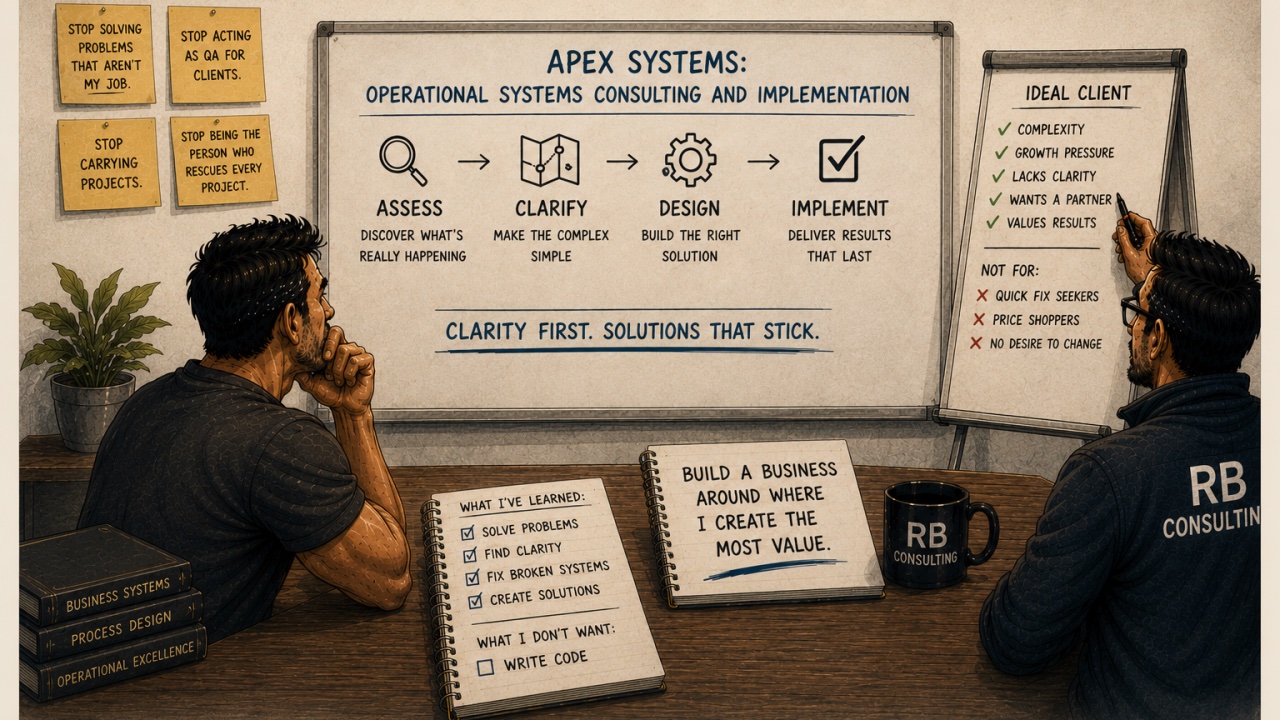
The pattern it reflected back: Apex Systems was becoming an operational systems consulting and implementation firm.
“How do you feel about that statement?” Rob asked.
“I think that’s pretty much what I’m doing. And what I should be doing.”
Then, the part that actually scared him.
“I just don’t know what that pays. With code, we kind of know what things are worth. This is unknown waters.”
Rob named the trap directly: chasing the money first usually backfires, because if the money disappears, you’re left doing something you only did for the money. Figure out the place you actually want to occupy first. The revenue model can be built around that — not the other way around. Businesses can tell the difference between someone selling what they genuinely believe and someone selling what they think the market wants to hear.
It was easy to say and hard to live by. Rob admitted as much.
“This is going to be tough for me too, in a sense — it’s a journey I’ve recently been on myself. The last thing I want to do is guide you somewhere you end up because of me, instead of somewhere you get to because it’s actually true for you.”
---
From there, the session turned practical.
Marcus began describing the assessment almost without thinking now. It maps workflows. Roles. Dependencies. Technology. Bottlenecks. Not to recommend solutions — to show a leader what actually exists, often for the first time.
“So many people I talk to — small, medium — they’re like, oh yeah, we’re constantly busy, we’ve got a lot going on. But do you really know what you’re doing?”
He had a live example sitting in front of him: “What I’m looking at at Meridian right now. No one knows what the hell my team’s doing. We have no oversight. I’ve brought it up multiple times, and it’s been ignored.”
Then, almost as an aside — the line that showed how far four sessions had actually carried him:
“And to the point we talked about — that’s not my job. So I’m not doing that anymore.”
The assessment stops short of solving anything. It identifies. Fixing comes later, as a separate engagement with its own scope and price.
Rob pushed on where the lines actually sit. What happens when a client asks for something outside the agreed scope? Marcus’s instinct was procedural — check the statement of work, write up a change order if it’s not covered.
Fine. But not quite complete.
“Tell them what you can do. Avoid leading with what you can’t. You catch more flies with honey.” Instead of I need to check if this isn’t included — flip it to let me check if this is included. Same boundary. Entirely different feeling on the other side of the conversation.
Marcus had his own version of the deeper line — the one between guidance and service.
“You’re not there to tell them their why,” Rob offered. “You’re there to help them implement their why.”
“Yes. That’s it. That’s it.”
He had a real example. A friend building a small vending machine business had asked him about APIs for inventory tracking. He didn’t build it for her — he told her what to research. She taught herself, vibe-coded her own solution, and was now closing in on being the macaron queen of Tennessee.
“Sometimes you just need a nudge. That’s the free guidance I’m willing to give. Not the kitchen sink.”
---
Near the end, Rob asked the question the whole session had been circling.
“Who is this for? And who is it not for?”
Marcus answered slowly, working it out as he spoke. Not large companies — too hard to reach the right people. Not small companies either — too cash-strapped, too distracted, too busy surviving to actually engage with what an assessment would show them. The sweet spot was the middle: established enough to listen, not yet so large they’d stopped being able to change.
“It is not for businesses that think they’re doing fine and don’t need to scale. Because then you’re just talking to someone who won’t listen.”
Then Rob asked the harder version.
“Which current client would fail that filter?”
Marcus’s first answer was instant: “Interestingly enough, Hargrove wouldn’t. But Hargrove is failing just because I didn’t price it right.”
Then he caught himself.
“Actually — no. There’s two folds to that.”
The assessment work itself — that part, Hargrove genuinely needed and had been right for. They were a business that needed someone to walk in and map what was actually happening. That part was a clean yes.
But somewhere in the second half of the engagement, it became clear they weren’t actually willing to change what the assessment revealed. They wanted the map. They didn’t want to use it.
“So it’s a yes and a no. The yes was at the start. The no came at the end — once we realized they were going to be reluctant to actually change anything.”
Rob caught the shape of it immediately.
“You started with the yes.”
It was, in its own way, the most honest answer of the whole engagement. Not every client who needs help is a client who’s ready to use it. And figuring out how to tell the difference — before signing the contract, not four months into it — was exactly the kind of clarity the filter was supposed to provide.
Marcus didn’t have that part solved yet.
But for the first time, he knew it was the actual question.
---
Most founders think the hardest part is figuring out what they do.
Often the harder part comes afterward.
Deciding who they’re willing to say no to. Because every offer becomes a filter. Every filter closes a door. And every closed door feels like revenue you’re choosing to walk away from.
Next week, Marcus brings back his first offer sheet.
The challenge won’t be deciding what belongs in it.
It’ll be deciding what doesn’t.