
Some names and identifying details in this series have been changed to protect client confidentiality. The consulting process, conversations, and outcomes are real.

---
Last episode, Marcus built his first formal offer.
He came into this meeting expecting to refine it.
Instead, the first thing out of his mouth was this:
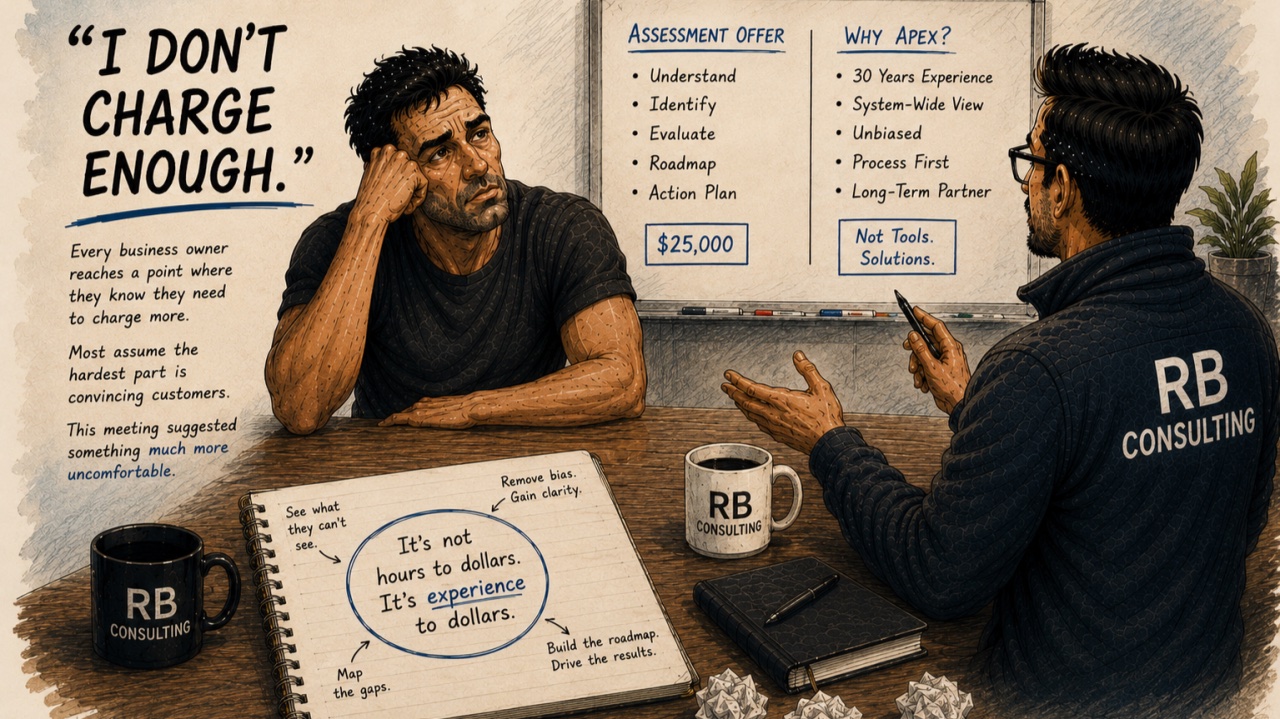
“I don’t charge enough.”
---
Every business owner reaches a point where they know they need to charge more.
Most assume the hardest part is convincing customers.
This meeting suggested something much more uncomfortable.
---
The week itself had been more of the same. No water at the house — the well pump had gone out over the weekend, four days without running water, sick dogs, Rachel still not fully recovered. At Meridian, Ryan was still systematically dismantling Marcus’s code in standup. Hargrove was close to go-live but not there yet.
Marcus had tried to take the weekend off.
That hadn’t happened either.
He’d had enough time, in between everything, to run the numbers on what Apex Systems would need to earn for him to walk away from Meridian Financial. To stop being a contractor and just run his own business.
The numbers didn’t work.
“I don’t charge enough.”
Rob heard it and didn’t move past it.
“Why did that feel obvious to you?”
“Because when I started running the numbers and trying to figure out if I could quit Meridian, I can’t. So apparently I’m not charging enough.”
“What was the hardest part in putting together the offer this week?”
Marcus didn’t hesitate.
“How much is my experience worth?”
He said it like a question he’d been sitting with for days. Maybe longer.
“The biggest thing for me has always been the justification for what I charge. How do I justify that with my service? Because a lot of businesses don’t understand the tech to understand the value we provide.”
Rob let that sit for a moment.
Then:
“Are they supposed to?”
Marcus blinked.
“Well, I mean — if I say it’s gonna cost you twenty-five grand for this assessment, here’s what you’re gonna get out of it, and you get to the end and you provide what you say you’re gonna provide, and they don’t feel they got value out of it… was the money justified?”
“So have you had an issue with that, or is this something you’re regularly getting pushback on?”
“I’m regularly getting pushback on this.”
“Which makes you think what?”
“That I’m looking at the wrong customers. Or maybe it’s just a confidence issue still.”
---
Rob shifted.
“Somebody’s looking at your assessment. What makes you special? What makes you different?”
“I have almost thirty years of experience building systems, working with businesses. Determining their problems, customizing and organizing their systems.”
“Good. Why don’t they just buy Microsoft Copilot, or ChatGPT, and have AI give them an assessment?”
“Out-of-the-box tools don’t always solve all of your business answers. You need to look at your overall processes and find a system-wide solution versus a tool-based solution.”
“How do you provide a system-wide solution as opposed to a tool-based solution?”
“The assessment reviews your business, your flows. We give you an overview of where you’re lacking, what systems need to be put in place, what needs to be improved. Or what you need to stop doing altogether before you add more tools to the chaos.”
“What’s different about this versus getting a software developer?”
“Developers are like tools. You need to understand your organizational infrastructure, the overall systems you currently have, before you start building anything or buying anything. It’s the same process as doing your research before you build a house. Same goes with software and business.”
“So a developer is basically just another tool.”
“Correct.”
Rob paused.
“I think developers will be insulted by that.”
A beat.
“But you’re not wrong.”
Six sessions ago, Marcus was the developer. Now he was the person deciding whether to hire one.
---
“What does a founder actually get from the assessment?”
“You get an understanding of what you’re missing about your business. Where your gaps are. And even what you’re doing right — they may have one process that they need to stop doing everything else and just focus on, and they could go gangbusters. Companies that try to figure out how things are broken internally can have blinders on. An external assessment removes that bias. Gets them an outside view of how their company actually works.”
“What happens if they don’t buy it?”
“Your current business continues as is. If you’re dealing with large internal system problems, you’re not going to be able to scale. You’re going to be stuck where you’re at.”
“What happens after the assessment?”
“We define a roadmap. How to fix your current internal systems, processes. How to scale those processes so you can grow.”
“Do they get the roadmap as part of the assessment, or is that a follow-on?”
“It’s an action plan. The action plan leads to additional consulting to help achieve it. Or they can take it elsewhere.”
“What if they take the roadmap and don’t use Apex for implementation?”
“That’s fine. I’m focused on the assessment. They can take it elsewhere. If they do a great job, great. If they don’t — they’ll be coming back to my door. To have it done the right way.”
Rob didn’t interrupt.
He moved to the next question.
---
“Where does that value come from when you’re doing this assessment?”
“The value for the business is their ability to understand what they’re missing. Where their gaps are. Even what they’re doing right. Companies working internally can have blinders on. They overlook everyday processes, manual processes. They just don’t see what they don’t know. An external assessment helps remove that.”
“And as you’re thinking through this — what is the value that you bring?”
Marcus answered slower this time.
“I’ve been doing this for thirty-some years across multiple industries. I’ve seen just about every combination of broken processes, internal conflict, failed systems.”
He stopped.
“I know what I’m looking for.”
Rob’s response was quiet.
“I would suggest remembering that.”
---
Then came the question that changed the direction of the conversation.
“Do you feel like the value you bring to the table is worth the price tag attached to it?”
A beat.
“I’m not asking if customers think that. I’m asking if you think that.”
Marcus answered immediately.
“Yes.”
Then neither of them spoke.
Marcus looked back at the notes in front of him.

Finally:
“But justifying that to the customer when you get pushback — I don’t know how to defend that sometimes. If this was software, that’s one thing. But assessments are slightly different.”
“How do you see those two as different?”
“I’ve got twenty-five years of experience writing software. I’ve only been doing assessments formally for a couple of years.”
“So the software feels backed by credentials. The assessment feels like it still needs something.”
Marcus didn’t push back.
“Here’s what I’d push back on,” Rob said. “Pricing software isn’t actually about the hours. It’s just easier to pretend it is. A hundred hours at a hundred dollars an hour — that math is comfortable. But what you’re really charging for, even then, is the experience to write those hundred hours of code instead of five hundred. You’ve been charging for experience this whole time. This is the same thing. It’s just more honest about what it actually is.”
“It’s not hours to dollars,” Marcus said. “It’s experience to dollars.”
“Yes.”
“And justifying that—”
“You’ve been doing it for thirty years,” Rob said. “You just called it something else.”
---
There was a longer conversation about the offer structure — about whether implementation even needed to be part of what Apex Systems sold. The Hargrove engagement had made that question hard to ignore. The assessment part Marcus had loved. The assessment part had gone well.
It was everything that came after — the building, the training, the handholding through resistance to change — where the months had piled up and the finish line kept moving.
“If you’re already saying you don’t enjoy it, it’s been a mess — is implementation a required piece of your service?”
“That’s what I don’t know yet.”
Not defensive. Just honest.
*”And that’s okay. You’re putting this together from the ground up. Not knowing is better than saying yes or no before you’re ready.”
---
The homework for the week wasn’t about refining the offer.
Find three to five business owners in the target market. Don’t pitch anything. Don’t try to sell. Just have a conversation. Ask where things are moving smoothly and where they’re not. Ask what happens if they disappear for a week.
Ask the questions Marcus had spent six weeks learning to ask.
And see what comes back.
---
Near the end, Rob said something that broke slightly from the consulting frame.
“I’ve been very impressed. I’ve been very happy to see how this has gone. Part of that — a very big part — is you. How you’ve done the work. Spent the time thinking things through. Been open to change. Even reassessing some of the most core things.”
He paused.
“There was a huge cost to coming to a point of saying, maybe I’m not a developer. Those kinds of things speak volumes.”
Marcus didn’t say much in response.
He didn’t need to.
---
Later — after the call, after the notes, after everything — Marcus looked back at what he’d built over the past six weeks.
An offer. A framework. A way of describing what he does that finally matched what he actually does.
The assessment wasn’t the thing that still needed work.
Next week, he wasn’t going to pitch it.
He was going to find out whether he finally believed it.