Some names and identifying details in this series have been changed to protect client confidentiality. The consulting process, conversations, and outcomes are real.

---
Six weeks ago, Marcus came into his first session carrying everything that felt wrong.
The clients. The house. Rachel. The business he couldn’t find time to build.
This week he came in carrying a document.
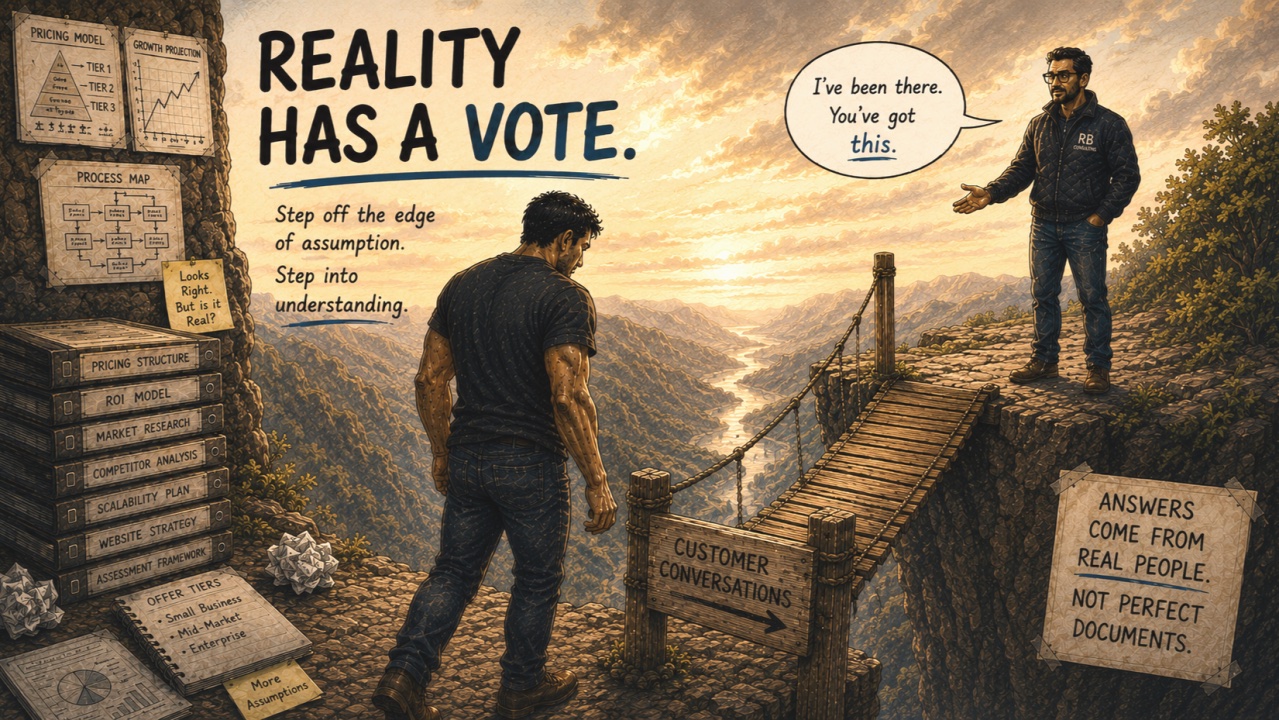
Thirty pages. Three assessment tiers. Pricing models. ROI projections. Timeline estimates. A pre-filter concept for the website. A scalability plan for when he eventually needed to hire.
The interviews — three to five business owners, no pitch, just questions — were still on the list.
---
“I went scatterbrain,” Marcus said. Not defensively. Just accurately.
“I had too much to think about for the assignment. And I just went.”
He’d re-listened to the recording. Had AI pull out the summary and the homework. Had gone back through it himself. And then he’d started building. The holiday weekend had complicated things — Rachel had made plans, there had been eight-hour meetings, travel, twelve-hour days. The conversations hadn’t happened.
But the document had.
Rob looked at what Marcus had put together and didn’t say anything right away.
“Let’s walk through what you built.”
---
The three tiers were organized by urgency. Companies where things were on fire. Companies that were stable but hitting growth pains. Large, complex organizations carrying too much accumulated weight. Each one had a target customer, a timeline, an hour estimate, an ROI projection, and a price.
Marcus walked through the logic. Rob asked questions. He played the skeptical buyer — a mid-size company, professional tier, a roadmap for the next six to twelve months, and the price came out to ten thousand dollars.
“Why is it ten thousand?”
Marcus answered. Experience. Customization. Not cookie-cutter. A roadmap built specifically for that company. The kind of thing that gets you ten to fifteen percent back in workflow efficiency, reduced redundancy, better processes.
“Basically everything you’ve got right now is hypothetical,” Rob said. “Almost all based on assumptions and market research. Not hard details and facts.”
“Right.”
“I’m not judging it. I don’t have enough information to judge it yet. But you’ve essentially built a pricing model for conversations you haven’t had.”
---
They kept going. Marcus talked through how he’d thought about scaling — if he automated enough of the process, trained someone to handle the documentation piece, he could take more clients without raising prices. He talked about what questions he’d ask in the discovery conversations. He talked about the pre-filter tool for the website — a form people would fill out before the first call, a way to qualify leads automatically.
He was mid-sentence when he caught himself.
“Again — I’m thinking too far ahead. I’m trying to reel it back.”
That word.
Again.
He didn’t need anyone else to say it.
---
“Are you being productive, or are you being busy?”
A pause.
“There’s a comfort in generating stuff. When you’re stuck trying to figure a problem out, sometimes it’s easier to shift gears. Build a lot of things. Say at the end of the day — I got stuff done. Even if you didn’t get the thing done.
Eat the frog. What is the thing you’re afraid of, intimidated by? If you got to the end of the day and said, at least I got that one thing done — that’s probably the thing that was actually worth doing.”
Marcus didn’t argue with any of it.
“I thought I was doing the assignment. I wasn’t thinking I was being busy. I think the problem was it was a split focus. I spent time on the pricing and the market research, and I think that bled too much into the actual assessment work. I just got carried away. But I totally get what you’re saying. Because when I scroll down to page 22, I’m like, yeah, I remember why I went down this rabbit hole.”
He paused.
“And I know I need to talk to people. At this point, there is no more documentation for me to build.”

Later in the session, Rob brought up something that had happened on his end.
He’d taken Marcus’s questionnaire — the discovery questions Marcus had drafted a few weeks earlier — and run his own business through it. He’d answered the questions honestly, he thought. One of them was about handoffs. About getting information out of the founder’s head. About what happened to the business if the person carrying that knowledge disappeared.
He’d answered: not a problem.
“And this is very interesting. Because I am somebody who preaches this on a daily basis. I talk to multiple people every day. I bring this up. I help them work through it. I help them do the things to not have that blind spot and to overcome it. I am actively doing it for myself.
And even within that, I still answered the question like it was not a problem at all.”
He’d gone back. Dug into it. And found that the last time he’d actually tried to hand that knowledge off, it had been very difficult. Very bad. But because he hadn’t tried it again since, the answer in the moment was: no problem.
“Sometimes people are going to say, yeah, it’s fine. Until you dig a little deeper and realize — no, it’s not fine.
Don’t let the first answer be the only answer.”
No one said anything. A long moment of silence hung.
Then Rob moved, “No new templates,”* Rob said near the end. “No revised pricing sheet. No expanded assessment package. And a bonus rule — you are not allowed to create or revise any assessment assets until the interviews are done.”
Three discovery conversations, minimum. Business owners, operators, past contacts — anyone who could give a real answer to a real question. What’s harder than it should be. What slows down. What depends on one person. What happens if nothing changes in six months.
And for each one, at least one follow-up. Not just the first answer.
“When was the last time that happened? What did it cost? Who had to fix it?”
“Once you start doing it,” Rob said, “it changes you very quickly. Changes you, your organization, everything you want to do, how you see it, what your confidence level is in all of this.”
Marcus was quiet for a moment.
“It is also a shift in business. Not just a shift in mindset.”
---
He’d spent seven weeks building an offer for a market he hadn’t spoken to yet.
None of that would tell him what he still didn’t know.
Whether anyone needed it.
What they’d actually say when he asked.
What he’d hear when he stopped building and started listening.
You don’t eliminate uncertainty by thinking harder.
You eliminate it by letting reality vote.
Marcus had been thinking for seven weeks. Carefully. Thoroughly. Honestly.
The document was the proof of that.
And it still couldn’t answer the only questions that mattered now.
Those answers were somewhere out there, in conversations he hadn’t had yet, with people he hadn’t called.
The only direction left was toward them.