
Some names and identifying details in this series have been changed to protect client confidentiality. The consulting process, conversations, and outcomes are real.

---
Last episode, Marcus was handed the simplest assignment in eight weeks.
Find people. Ask questions. Stop building.
He came back with three interviews, a narrowed hypothesis, and a week that rated a two out of ten.
Both things were true at the same time.
---
Meridian Financial had been a dumpster fire.
Ryan had spent the week consolidating six open tickets into one master ticket — abandoning work Marcus and the rest of the team had already completed — and positioned himself as the person who’d finish it all. Monday, Tuesday, Wednesday: standup calls where Marcus’s work got picked apart in front of the group. He’d put himself on mute and kept his mouth shut.
“Ryan just has way too much control.”
Rachel had eventually sat him down.
“You’re in this cycle again where you’re gonna quit your job because you’re bitchin’ about things out of your control.”
He’d reset a little. But the week had still been what it was. He knew she was right. That didn’t make it easier to hear.
Rob heard it and didn’t linger.
“Hopefully we’ll give you something better to think about.”
---
The interviews had happened.
Three of them. The hypothesis had narrowed toward owner-led service businesses — five to twenty-five employees, places where the owner was the business in every way that mattered. Too small for enterprise solutions. Too busy to see what they were missing. The kind of company where one bad week could cost $2,500 and nothing was in place to prevent the next one.
Before getting into any of it, Marcus offered something unprompted.
“One thing the interviews have helped with is learning to start talking to customers. Listening to them. Trying to understand their pain points.”
He paused.
“I’m still leading with my questions a little more than I should be. But I’m starting to catch it. The biggest revelation is I’m still talking too much about what I think customers want to hear — and not listening to what they actually need.”
Eight weeks earlier, Marcus had described a business that could solve everything for everyone. Now he was catching himself mid-question, noticing when he was steering a conversation toward his own assumptions instead of following where the customer was actually going. The interviews hadn’t just gathered information. They had started changing how he listened.
The strongest conversation had been with Bill.
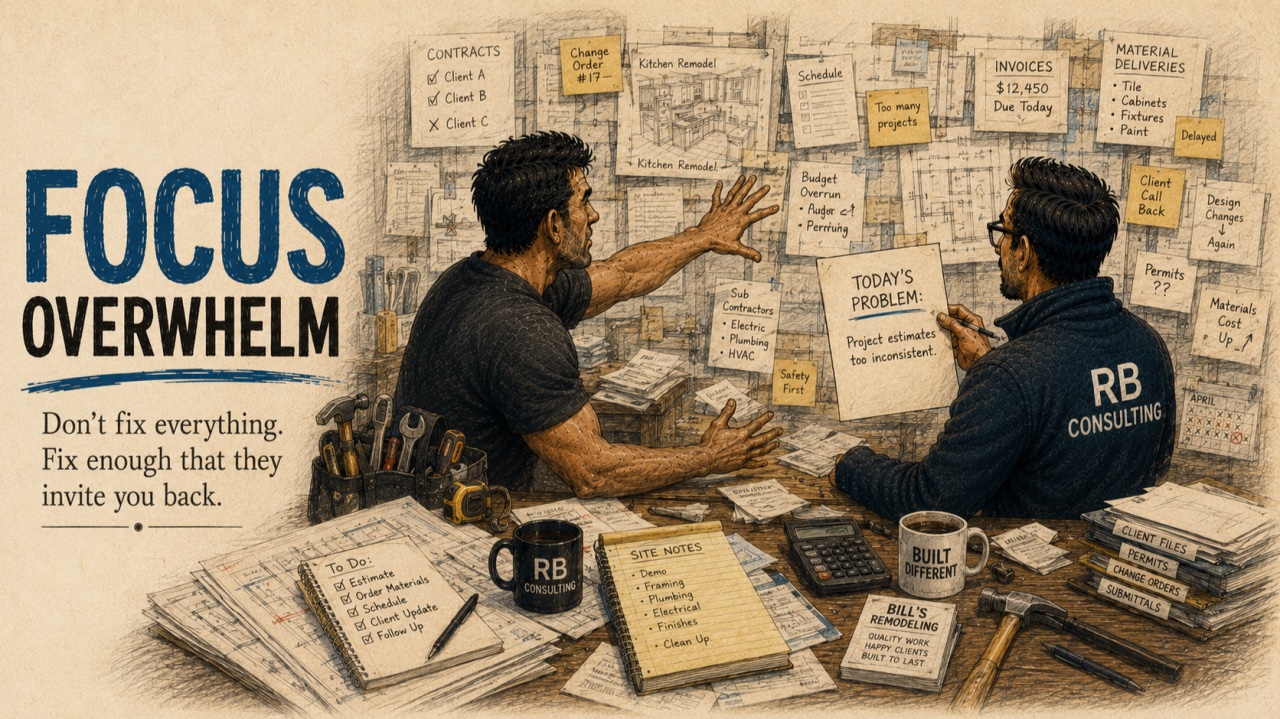
Bill ran a small remodeling business. He was the estimator, the scheduler, the supervisor, and the person the whole operation leaned on. His contract bible — a physical notebook he carried everywhere — was the closest thing the company had to a system. One app told him what materials to buy for a job. That was about where the infrastructure ended.
He’d recently caught three employees taking a two-hour lunch and fired them on the spot. He’d found out after the fact because he had no way to know in real time. He’d lost roughly $2,500 in a recent disruption he couldn’t have predicted, because nothing was written down.
He’d told Marcus he needed help immediately.
“Everything is in his head.”
---
Rob asked what Bill was actually looking for.
“Sanity,” Marcus said.
“What does sanity look like? Thirty days later — what’s different?”
Marcus answered. GPS tracking for employees. Time tracking. A clear contract list that existed somewhere other than his head or his calendar. A business that looked like a business.
Rob kept going. “Is he still working till midnight?”
“Oh, yes.”
“Does every job have a defined scope?”
Marcus walked through the realities — construction work had unknowns, costs that didn’t fit into bids, variables that appeared after you pulled up the baseboards. Bill was also undercharging. The apps he’d tried all told him to charge more. He made more money on insurance claims than personal projects because he didn’t want to charge elderly customers what the insurance company would pay without blinking.
“He knows he can’t scale. He knows he’s barely holding on.”
“So where do you begin?” Rob asked. “He calls you tomorrow night. You start tomorrow. First task?”
Marcus answered. Get everything out of his head. Map the day, then the week. Understand how the business moves from contract to payroll to payment to taxes. Understand the process before touching anything.
Rob listened.
“What I’m hearing is tracking. Tools. You’re going to give me a list of your problems, and we’re going to give you a tool. How does that give him sanity?”
“No,” Marcus said. “He’s already looking at tools. I want to understand the process from beginning to end. How his company works. And help him put a process in place to organize it better.”
Rob nodded. Then:
“Which tier of assessment does what you’re describing fall under?”
“Mid to enterprise.”
Rob let that sit.
“Bill is a guy with a handful of employees who is barely surviving. And you’re going to give him a mid-to-enterprise assessment.”
Marcus knew it as soon as it was said back.
He’d sat with Bill’s story for days. He’d thought about what it would mean to help him, what was possible, how far things could go. All of that thinking had led here — to the fullest version of the solution, again, before anyone had asked for it.
Rob walked through it carefully. Three pain points: lost wages, unreliable employees, can’t keep up with the work. In thirty days, with a full enterprise assessment, what did Bill actually have to help with any of those three?
“Nothing at the moment.”
That sat differently than Marcus expected it to.
Marcus pushed back. If he jumped straight to the surface problems, he might only be treating symptoms. The real issues might be upstream. He might put a band-aid on something instead of fixing it.
“Do you need to assess the entire organization to help him?”
“In my mind, yes. Because Bill — it’s all in Bill’s head. And unless I can get it out of his head, what I’m getting from his pain points may not truly be the right solution.”
Rob didn’t argue with the logic. He redirected it.
“If somebody comes into a hospital and they’re bleeding — arm’s been cut off — but they also happen to have terminal cancer... they don’t care that the doctor spent three days determining they have terminal cancer. They want the arm dealt with.”
“This is where ‘Reality Gets a Vote’ comes back. Yes, we can argue all day that people should do things the right way. But reality is messy. Reality is that they do what they can when they can. Bill’s in survival mode. He’s not in scaling mode.”
---
Then Rob played Bill.
“I’ve got $2,500. That’s it. I would love it — it sounds like you might be able to help me with my pain point. What about that?”
Marcus didn’t freeze.
“That would be a service, not an assessment. Taking each individual pain point within the budget. Tailoring what can be completed within that. Delivering it. If he takes it, he takes it. If he doesn’t — not the right fit.”
“So why not start with that?”
“Because at the start of this you told me to stop doing that.”
“I did not say stop doing that.”
A beat.
“From the beginning of this, you told me not to put the cart before the horse. So I was trying not to do that.”
Rob walked it back. Stopping Marcus from designing solutions before understanding the need was different from stopping him from solving a clearly stated problem. Those weren’t the same thing. Bill’s need was known. Bill had said what hurt. The question wasn’t whether to help — it was how much to take on at once.
“The best approach for Bill may be a one-off, and a one-off, and a one-off. He can eat the elephant in smaller bites.”

Before the session ended, the question came that wasn’t about Bill at all.
“How are you gonna feel if you give him your estimate and he says no? I can’t afford that. I’m gonna have to wait two years.”
Marcus sat with it.
“My gut is to just jump in and help them. But I’m trying not to do that. Because that’s where I get in trouble.”
He paused.
“I do want to help. The guy’s struggling. I can help him.”
Then, quieter:
“But that’s exactly what I thought going into Hargrove.”
He stopped there. And then added the thing he’d been sitting with since the session began.
“Early on, we talked about getting into trouble chasing money instead of chasing what’s good for the brand. That’s what I was trying to be careful of. Jumping in before I know if it’s really what Apex Systems should be doing.”
He didn’t need to say more. Everyone in the room knew where Hargrove had ended.
What came back wasn’t a correction. It was recognition.
“You’re the kind of person who doesn’t want to see somebody struggle. You want to see them succeed. So you want to give them every tool they need to do that — whether they see it or not. You realize where their gaps are, and you want to help.”
Marcus didn’t argue with that.
“That’s already come back to bite me.”
“I know. And it will again, if you’re not careful. Because that instinct — it’s not a flaw. It’s genuinely who you are. But there’s a difference between seeing the path and deciding it’s your job to walk someone down it before they’re ready.”
A pause.
“Sometimes just because you see the path doesn’t mean they’re ready for it yet. You start with paper and a pen. Then you move to Excel. Then you move to tools. That’s the way everybody builds a business. Bill is building his. He has to do it his way.”
Marcus nodded slowly.
“I’m trying to be careful. I’m trying to protect the potential relationship.”
He’d wanted to help Bill from the moment he heard his story. He still did. That hadn’t changed. What had changed — what eight weeks had quietly built — was the ability to hold that instinct up next to his own experience and feel the weight of both at the same time.
---
The session ran out of time before the conversation did.
The homework came in two parts.
First: two more interviews. Not information gathering. Not assessments. Go in with a hypothesis — something specific Marcus thought might be helpful — and test it. See what comes back. Make it a routine. Make it muscle memory.
Second: build Bill’s offer.
Bill had lost $2,500 when his business went down for seven days. That number was sitting right there. So the question Rob sent Marcus home with was precise: if Bill walked in tomorrow and said I’ve got $2,500 and I think you can help me — what would Marcus actually sell him?
Not a scaled-down version of the full assessment. Not a compromise. A real answer to a real question: what can be done for that amount, for this specific person, that solves the problem keeping him awake?
What are the deliverables? What does the engagement look like? What problem, specifically, does it address?
One page. Simple enough that Bill could read it and decide.
Marcus left without a finalized offer. Without a price that felt settled.
But for the first time in eight weeks, the homework wasn’t about building a framework or refining a document.
It was about answering a question a real person had already asked.
I’ve got $2,500. Can you help me?
Somewhere in his notes was the answer to that.
He just had to find it before August 1st.