Although there are still holdouts, we are moving to a world where remote work is typical. The regulars at local coffee houses, Starbucks, and Panera are just part of the proof. You can also find some “rent-a-space” options in many cities where a temporary office is available for travelers or those that need a change of scenery. When you have a job that is sometimes at an office and sometimes on the road, it can be frustrating to keep up with all of your tech and office supplies. These times are when a “go” bag comes in handy.
Remote Work Still Requires Power
Paper and writing implements are important in a go bag, but power plugs and cables are even more critical. We are a connected generation that needs our electronic tools. Whether it is a tablet, a smartphone, or a laptop, power is essential. Even though battery life for these devices is getting better, you never know when you will need more. In fact, Murphy’s law tells us that we will need that plug or cable most when we do not have one available.
That leads to the first thing that is good for your bag. A cable, plug and maybe even recharging block for your primary devices. I have found these to be highly useful over the last few years. I have also purchased these items solely for my “go” backpack. That way I never take them out (and risk the chance of forgetting where I put them) unless I need them away from my office. If you share time in an office and at home, then a second or third power cable for your laptop is essential. It is too easy to rush out the door and leave a cable behind. That can ruin a weekend trip where you were going to catch up on work.
Travel Comfortably
I have been surprised at how useful an extra set of earbuds and a headphone-mic combo have been in recent years as well. It is hard not to take calls and holding a phone while taking notes is almost impossible. Of course, you can always use the phone or device speaker, but that can make it easy for others to eavesdrop. Oh yeah, it also is annoying to be “that guy” that is having a conversation everyone in the room has to listen to.
As a bonus, carrying headphones makes it easy to relax to music, listen to a podcast, or catch up on your favorite movie or TV show when on long trips or commutes. I recommend you have a few select apps, albums, or movies for those longer trips. There is a world full of audio-visual options to match your every mood. These can be a great way to relax even while traveling.
It Is Easy To Create Your Bag
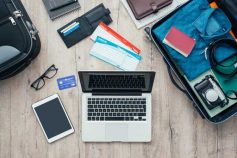
A “go” bag might be your laptop bag or backpack. That is often a great solution since you are not likely to forget to throw your laptop in its bag. That is how useful such accessories are. You may have noticed that these sort of bags have pockets and compartments for all sorts of tools and accessories. Take advantage of these. Throw a spare of things you use a lot. These spares might be batteries, cables, pencils, or “emergency” items like some aspirin or toothpicks. Kleenex is one of those things we can always use and small tools like an eyeglass repair kit can be a lifesaver. The better stocked your bag, the less likely you will find yourself caught short during your remote work.
I would be remiss if I did not mention a few items that are not needed very often, but valuable nevertheless. Adapter plugs for things like a video display or power supply are important for those that do presentations. You can always use your laptop or tablet display, but it looks more polished to be able to plug into the local large screen display. USB powered items can save you headaches as well. Many laptops have a backlight on the keyboard, but if yours does not then I recommend a USB light clip. These can allow you to work in low-light situations like riding in a vehicle at night.
Everyone has their own favorite tools and accessories so your list may vary considerably from mine. The key is to have the things you need most in a place that is easily accessible as you are running out the door to a client meeting. Try creating your own “go” bag and see how much it helps you do a better job on the road or your remote work office.